OnlyFans chatters: who is really answering your DMs?
Many large OnlyFans accounts hand their inbox to an agency whose chatters write as the creator. What that means for what you pay for, and what you can check.
On a large OnlyFans account, the person writing to you is often not the person in the photos. Creators hand their inbox to agencies, and agencies staff it with chatters who write as the creator, in shifts, from scripts, with software that shows how much each subscriber has spent. This guide covers how that works, what it changes for what you pay for, what is and is not illegal about it, and the few things you can check before you spend money on chat.
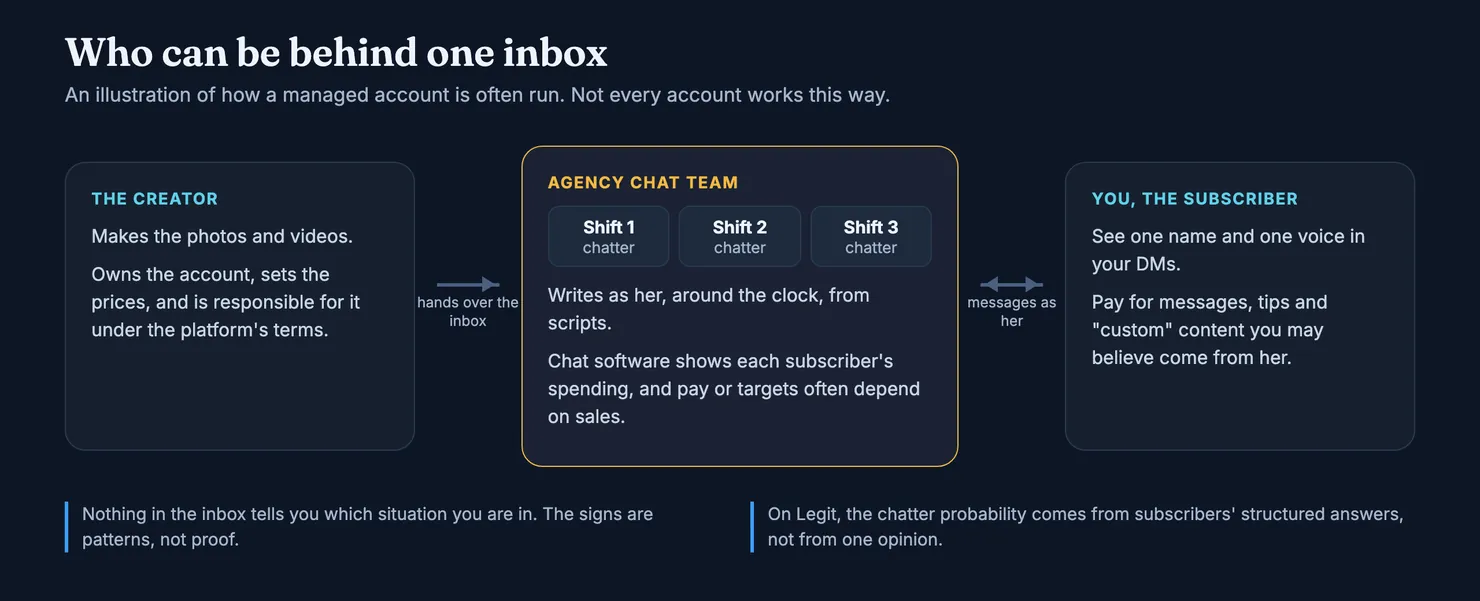
What an OnlyFans chatter is
A chatter is someone paid to answer a creator's direct messages as if they were her. On a small account, the creator usually writes her own messages. As the account grows, the inbox turns into the main source of income: tips, pay-per-view messages, custom requests. Answering it becomes a full-time job, and many creators then pass it to a management agency that runs a team of chatters.
None of this is hidden from creators. Agencies sell "chatting" openly, alongside promotion and account growth, and the job ads are everywhere: people searching for chatter jobs outnumber fans asking who is behind the messages. What is hidden is the other side. The subscriber sees one name, one profile picture and one voice.
How do OnlyFans chatters work?
The accounts that have come out are consistent. A journalist who took chatter jobs for Wired describes being handed a memo about the woman he was to play: her tastes, her "chatting style", and a price list for the videos in her vault. He worked an eight-hour evening shift with nearly a hundred unanswered messages waiting, inside chat software that showed what each subscriber had spent. A supervisor reminded him to push paid content to the men who seemed most aroused.
A chatter in the Philippines told the BBC she earned under two dollars an hour, worked to sales targets set for each shift, and sexted with several fans at once. Both accounts describe the same thing: shifts that cover the whole day, scripts and openers, and a job measured by sales.
OnlyFans chatting services: what the creator buys
From the creator's side, a chatting service buys time and revenue. She keeps making content; someone else turns subscribers into buyers. Some creators run a small team themselves, some keep a few conversations for themselves and hand over the rest, and some write every message. You cannot tell which from the outside, and the platform does not say.
The arithmetic explains why the practice spread. A creator with a few thousand subscribers can receive hundreds of messages a day, and each one is a chance to sell. Answering them all herself would leave no time to make the content they are paying for. Delegating the inbox solves her problem; it simply moves the cost to the subscriber, who no longer knows who they are talking to.
Is it legal to use chatters on OnlyFans?
Short answer: no court has found that it is not, and OnlyFans' own terms, in the passages we read, do not forbid a creator from having help with her messages. That is not the same as saying everything a chat team does is fine.
What OnlyFans' terms say
OnlyFans presents itself as the venue, not a party to what you buy. Its terms say it facilitates "Creator Interactions" (subscriptions, messages, tips, purchases) but is not a party to the contract between fan and creator, and is not responsible for those interactions. The creator sets the prices and must deliver what was paid for. When Wired asked about chatters, an OnlyFans spokeswoman said the company is not affiliated with and does not endorse any agency, and that creators run their business as they see fit within the terms.
Terms change, so read the current version on onlyfans.com/terms rather than anyone's summary, ours included. Our browsers cannot open onlyfans.com, so we read the passages above in the Internet Archive's copy.
The lawsuit, and where it stands
Subscribers have sued. A case against OnlyFans' operator and others was filed in the US District Court for the Central District of California, framed under the federal racketeering law, and its public docket was still active when this guide was updated. The BBC reported that legal cases brought over chatters have not succeeded so far. A complaint is an allegation, not a finding, and we draw no conclusion from it about any account.
Chatters are not the same as OnlyFans messaging scams
A chat team working inside OnlyFans, selling the creator's content through the platform's own payments, is a business practice you may dislike. Someone who builds a relationship in DMs and then asks you to pay outside the platform is something else. The US Federal Trade Commission describes the pattern behind romance scams: frequent chat to build trust, a story, then a request for money by gift card, wire transfer, payment app or crypto, which is hard to get back. If a "creator" asks you to move the conversation or the payment off OnlyFans, stop there, whoever is typing.
Signs that someone else is writing
None of these proves anything on its own. Repeated and together, they are what subscribers report most often, and they are what the questions on Legit ask about.
- Replies at every hour. Instant answers at 4 a.m. and 4 p.m., every day, without a gap. A team in shifts does not sleep; a person does.
- No memory. She forgets what you told her last week, or mixes you up with someone else. Several people sharing an inbox do not share a memory unless someone keeps notes.
- Every conversation turns into a sale. Whatever you write, the reply heads for a pay-per-view message, a bundle or a tip within a few lines.
- Attention that follows your spending. Warm while you buy, distant when you stop. Chat software that ranks subscribers by spend makes this pattern likely.
- The same message, word for word. Openers and "I made this just for you" lines that other subscribers received identically.
- A voice that changes. Spelling, emoji habits, language or tone that shift from one day, or one hour, to the next.
- "Custom" content that is not. A video sold as recorded for you that is clearly older. The Wired reporter sold clips "filmed minutes ago" that were a year old.
Signs that mean little
A creator who rarely replies may simply be busy, or writing her own messages slowly. Short replies are not scripts. A sales pitch is not proof either: plenty of creators sell hard themselves. On Legit, "rarely replies" is recorded and shown but moves nothing in the chatter estimate, for exactly that reason.
What it changes for what you pay for
Paying for a subscription to see photos and videos is one purchase. Paying for messages, tips and custom content because you believe you are talking to her is another. If someone else writes those messages, the first purchase is unchanged and the second is not what you thought it was.
- Subscriptions. What you pay for is access to the feed. Who answers the DMs does not change that.
- Paid messages and tips. This is where the question of who is writing matters most. Do not pay for anything on the promise that it is personal unless you would be comfortable if it was not.
- Custom content. Ask for something specific and checkable. A vague "custom" is often stock from the vault.
- Private photos you send. Assume a stranger may see them, possibly several. That alone is a reason to think twice.
If something you paid for never arrived, our guide to refunds on OnlyFans explains what to ask for and why a chargeback is a last resort.
Before you pay for chat: a short checklist
A few habits cost nothing and protect you whether or not a team is behind the account.
- Ask, once and plainly. Some creators say in their bio or welcome message who handles messages, and some answer honestly when asked. A dodge is an answer too, though not proof.
- Mention something checkable. Refer back to a detail from an earlier conversation a week later. A person who reads her messages tends to remember; a rotating team often does not, unless someone keeps notes.
- Set a budget before you start. Chat is designed to sell, and the most effective sales happen in the moment. Decide what you will spend in a month, and stop there.
- Keep it on the platform. No gift cards, no transfers, no crypto, no "my other account". Paying through OnlyFans is what gives you its receipts and its complaint route.
- Keep your receipts. The emails OnlyFans sends are proof you paid. On Legit they also let you prove a subscription, which doubles the weight of your report.
- Turn off auto-renew if you only wanted a month. A subscription that renews quietly is the most common way people pay for more than they meant to.
How to check an account before you pay for chat
You cannot see inside an inbox. What you can do is look at what other subscribers reported about the same account, weighted by how believable each report is. That is what the chatter probability on a Legit profile is.
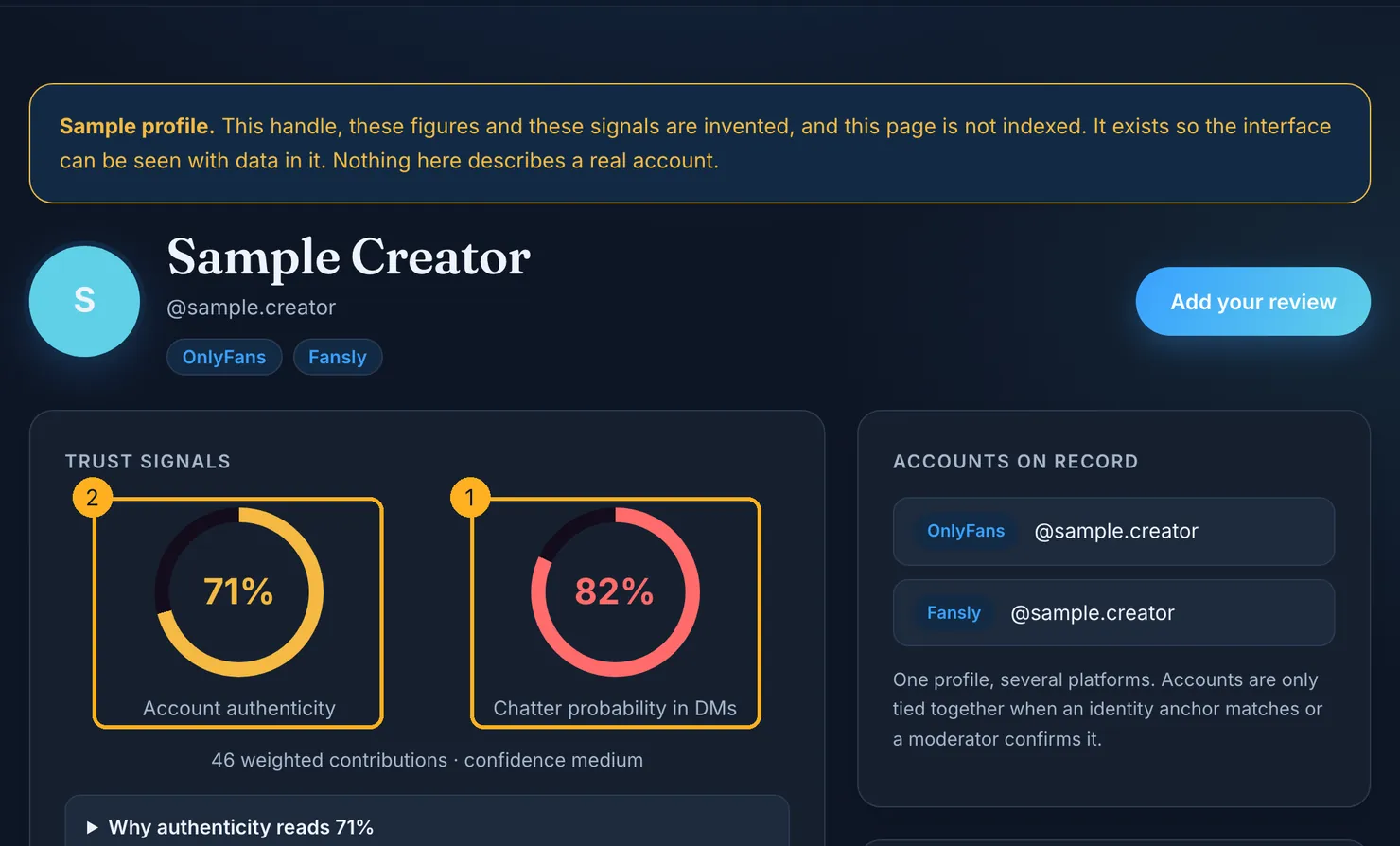
Search the account in the finder, then read the two figures separately. Authenticity asks whether the account belongs to the person it shows, and it rests on public facts, not opinions; our guide to spotting a fake account covers that side. The chatter probability asks who writes the messages, and it comes only from subscribers' structured answers.
What we ask subscribers
After a rating, Legit asks five questions. Two of them open only if you say you subscribed, because only a subscriber can answer them: did she remember your previous conversations, and did the attention change over time. They are the closest thing there is to a direct read on whether a team is behind the account.
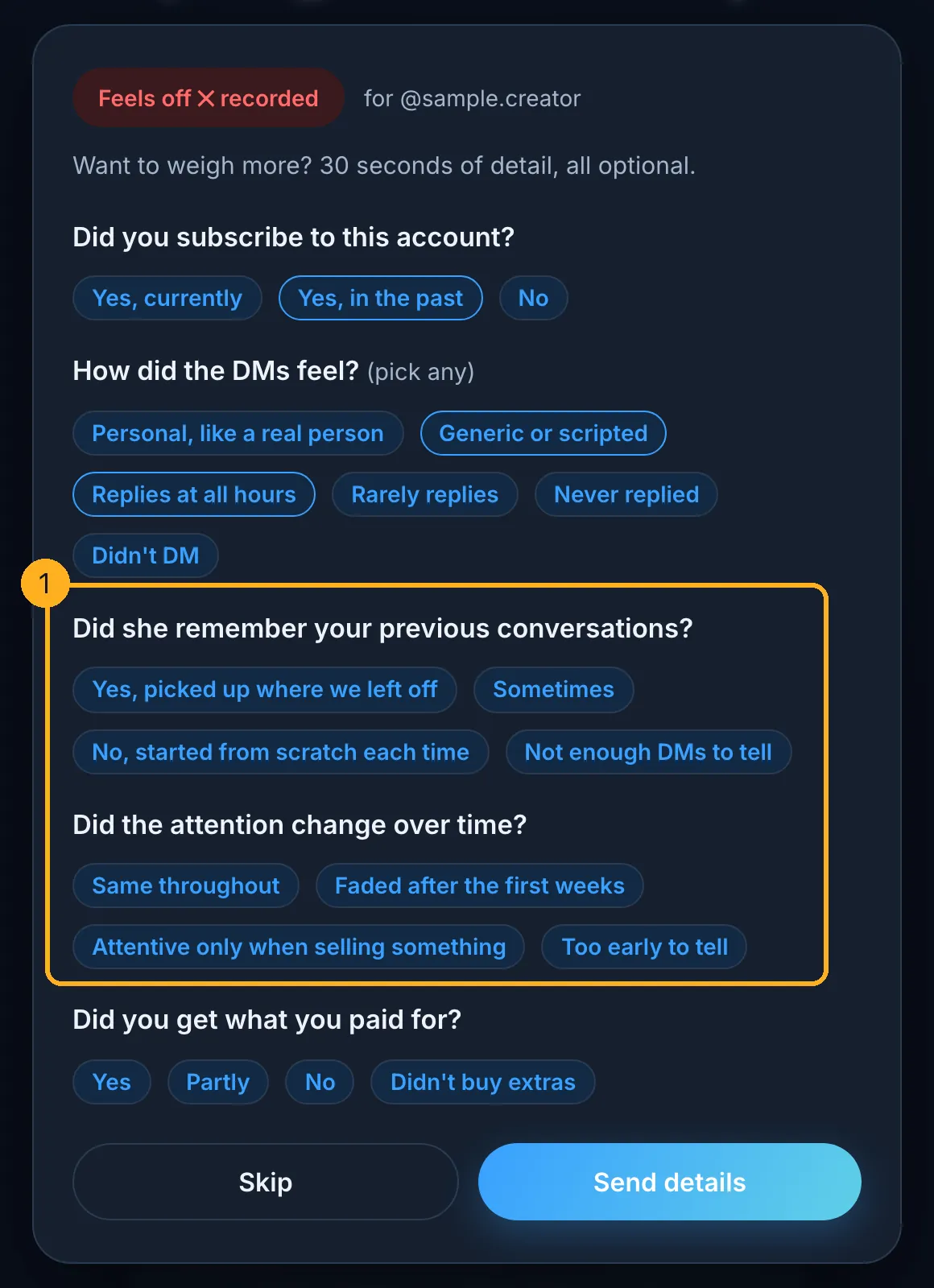
A report backed by the platform's receipt, checked by its signature, weighs twice as much as one without. A report from someone who says they never subscribed weighs half. Below a minimum of evidence no figure is published at all, and the profile says "not enough evidence" rather than guessing.
What each answer weighs
The rubric is published in full, loaded from the scorer itself rather than retyped, so what you read is what runs. "No, started from scratch each time" moves that report's estimate 25 points towards "someone else is writing"; "Yes, picked up where we left off" moves it 25 points the other way.
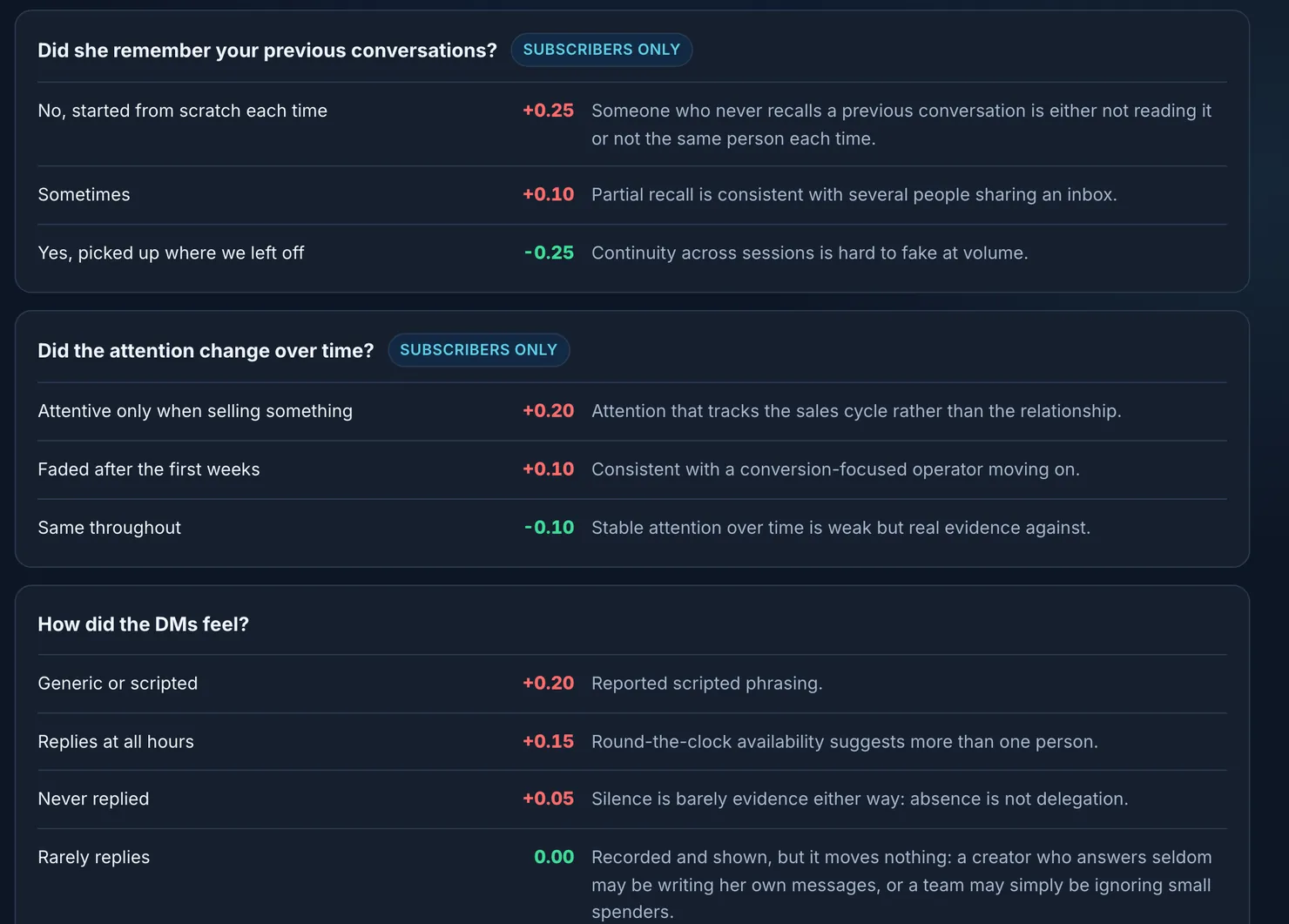
If you subscribed to an account, add what you saw. It takes thirty seconds, and the answers are what moves the number for the next person.
What a chatter probability cannot tell you
- It is not a verdict. A high figure means subscribers' reports point that way, not that anyone has proved who writes the messages.
- It says nothing about a given conversation. A creator may write some messages herself and leave others to a team.
- It can be wrong, and it can be contested. A creator can claim her profile, answer publicly and ask for a correction, without sending an identity document. Claiming a profile never moves a score.
- It does not cover AI. Software that writes messages raises the same question in a different form; our guide to AI chatbots on OnlyFans covers what is known.
If you want to understand the business on the other side, the guide to OnlyFans agencies explains what they sell to creators and what that means for subscribers.
Questions people ask
Is it legal to use chatters on OnlyFans?
No court has ruled that it is illegal, and OnlyFans' terms, in the passages we read, do not forbid a creator from having help with her messages. Subscribers have sued in the United States, but legal cases over chatters have not succeeded so far. Asking you to pay outside the platform is a different matter and a classic sign of a scam.
How do OnlyFans chatters work?
An agency gives each chatter notes on the creator they play: her tastes, her style and the prices of her paid content. Chatters work in shifts, often answer several fans at once, and use chat software that shows how much each subscriber has spent. Their pay or targets usually depend on the content they sell.
How can you tell if an OnlyFans creator uses a chatter?
You cannot know for sure from the inbox. Patterns worth noticing are replies at every hour, no memory of earlier conversations, every chat turning into a sale, attention that fades when you stop buying, and the same lines other subscribers received. One sign alone means little; several together, repeated, mean more.
How much do OnlyFans chatters make?
There is no reliable market figure. Two journalists' accounts give an idea: a chatter in the Philippines told the BBC she earned under two dollars an hour, and a Wired reporter was offered between one and five dollars an hour, sometimes with a small commission on sales. Agencies keep most of what chat brings in.
Can I get my money back if a chatter answered my messages?
Probably not on that ground alone. OnlyFans' terms ask fans not to make unjustified refund or chargeback requests and say the platform is not a party to what you buy from a creator. A billing error or content that never arrived is different: contact OnlyFans support first, with dates and amounts.