OnlyFans agencies, seen from the other side
Almost everything written about OnlyFans agencies is aimed at creators or at people who want to start one. This is for the person paying: what an agency takes over, and what that changes for you.
An OnlyFans agency is a company a creator pays to run part of her account for her. She still appears in the photos and videos. The agency takes over some or all of the rest: promotion on other social networks, the posting schedule, the prices of paid messages and, very often, the inbox. For you as a subscriber, that last part matters most. If an agency answers the messages, the person you are chatting with, tipping and buying from may not be the person on the page. Nothing about that is hidden from the platform, which deals with the creator and holds her responsible for everything done on her account. It is often hidden from you.
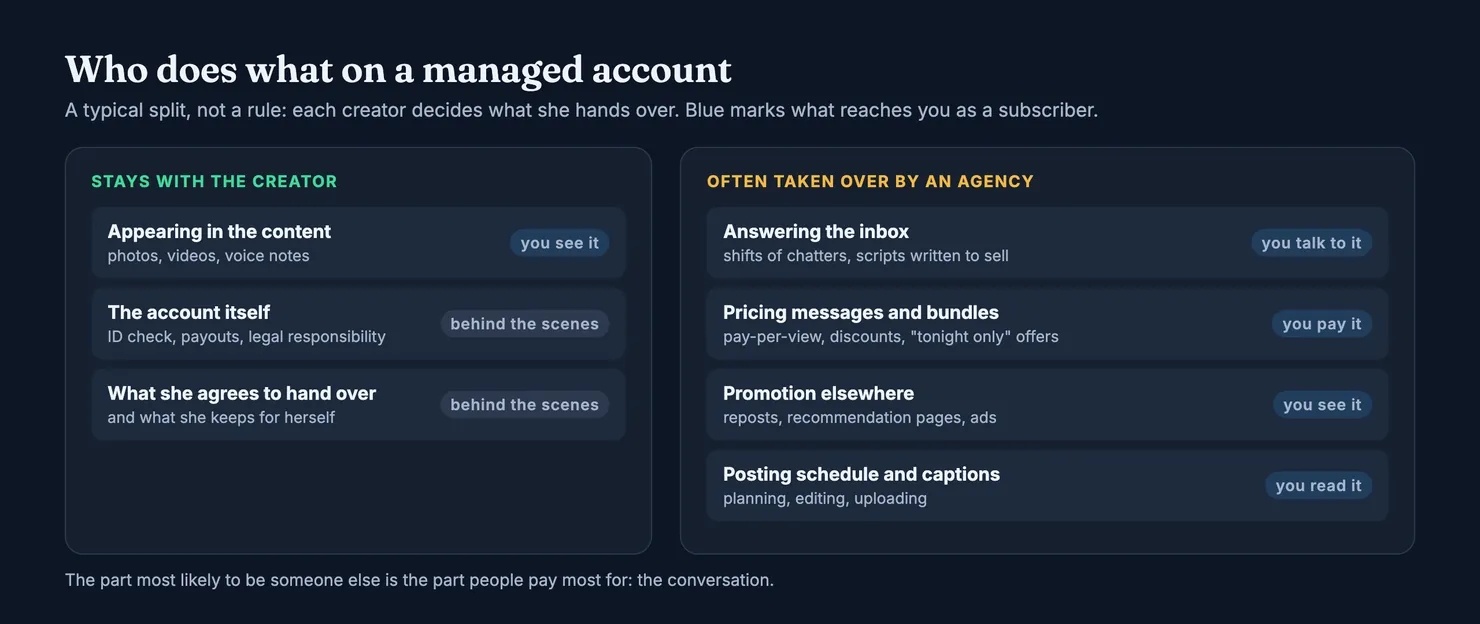
Nearly everything that ranks for this question is written by agencies trying to sign creators, or by lists of agencies. This guide is for the other side of the screen: the person paying. It covers what an agency takes over, what the platforms' own rules say about it, what advertising rules say about the promotion agencies sell, and what you can check before you spend money. We do not name agencies, recommend any, or explain how to start one.
A note on sources. Fansly's rules come from its help centre. Our browsers cannot open onlyfans.com, so for OnlyFans we read the copy of its Terms of Service kept by the Internet Archive. The advertising rules come from the US Federal Trade Commission and, in the UK, the Advertising Standards Authority and the Competition and Markets Authority. Terms and guidance change, so check the current version before you rely on a detail.
What is an OnlyFans agency?
It is a business that manages creator accounts for a share of what they earn. The names vary (management agency, marketing agency, OnlyFans manager), but the idea is the same: the creator supplies the content and her face, and someone else runs the shop around it.
Agencies are not specific to OnlyFans. Fansly has its own sign-up route for agencies, producers and other accounts that are not one person. Even then, Fansly's help page on agency accounts says the account is registered with the legal details of a primary account owner, and that this person is the one eligible for payouts. Its page on content featuring others adds that each account has one owner, the person who submitted the creator application, and that anyone else appearing in the content is a co-performer with separate consent papers.
What does an OnlyFans agency do?
From the outside, an agency's work falls into four jobs:
- Promotion. Bringing new subscribers from other platforms: reposts, short videos, recommendation pages, paid shout-outs.
- Posting. Planning what goes up and when, writing captions, scheduling.
- Pricing. Setting the subscription price, the discounts, and the prices of locked messages and bundles.
- The inbox. Answering subscribers, usually in shifts, often from scripts. The people doing this are called chatters.
Not every agency does all four, and not every creator hands over all four. Some keep the messages and outsource only promotion. Others hand over everything except appearing in the content.
Is an OnlyFans management agency different from an OnlyFans manager or a marketing agency?
Mostly in what they say they sell. A "marketing agency" tends to stress promotion and growth; a "management agency" tends to offer the whole account, inbox included. An "OnlyFans manager" is often one freelancer doing the same jobs for a handful of accounts. The labels are not regulated, so the word on the agency's website tells you little about who answers a particular account's messages.
Are most OnlyFans accounts managed?
Nobody publishes a reliable figure. The platforms do not say how many accounts use an agency, and the numbers that circulate come from agencies themselves, which have every reason to make the practice sound universal. What you can say is that it is common enough that a busy, fast-replying inbox on a large account should not be assumed to be the creator herself.
What changes for you when an agency is involved
Hiring help is not wrong in itself. Plenty of people pay someone to run their social media. The question for you is which parts of what you are paying for are still her, and which are not.
Who answers your messages
On a large account, the inbox is where most of the money is made: tips, pay-per-view messages, custom requests. An agency that runs the inbox is selling the creator a team that keeps those conversations going around the clock and turns them into sales. If you pay for messages because you believe she writes them, this is the part most likely to be someone else. Our guide to OnlyFans chatters goes through the signs subscribers notice, and the one on AI chatbots in DMs covers the newer case where software writes the replies.
What the prices are for
A team paid on results is paid to sell. Discounts that end tonight, bundles offered "just for you", a locked message after every friendly reply: none of this proves an agency is involved, and some creators sell this way on their own. It is, though, the pattern agencies are hired to produce, and it is worth noticing when every warm message ends with a price.
Where you heard about her
Promotion is part of the job, and some of it does not look like advertising: a "recommendation" page that reposts several creators, an account that comments enthusiastically under other people's posts, a glowing tip in a forum. That brings in the advertising rules further down.
What the platforms' rules say
Are OnlyFans agencies allowed?
The OnlyFans terms we could read do not ban outside help. They deal with it in one place: if someone else assists a creator with running her account, that does not change her legal responsibility. OnlyFans says its relationship is with the creator, not with any third party, and that she is responsible for all the content and for all use of the account (OnlyFans Terms of Service, archived copy). Opening a creator account requires an ID and two photos of the person, so the account is tied to one verified individual, whoever does the typing.
What those terms do not do, in the version we read, is say who may answer a creator's messages. We have not found an OnlyFans rule on chatters, and we will not guess at one. If it matters to you, read the current terms on the site itself.
Fansly is similar. An agency can sign up, but the account belongs to one verified owner, and its help page warns that impersonating any person or entity without explicit consent breaks its terms. That page says nothing about who answers messages either.
Can an agency use AI to answer fans?
On Fansly, not freely. Its help page on AI-generated content quotes its terms: without express written permission, content where AI systems talk directly with users to produce personalised replies without human oversight is not allowed, and neither is AI material passed off as an authentic human performance. That is a rule about software, not about human chatters, and the page does not say how oversight is checked. We could not read an equivalent OnlyFans rule.
For a subscriber, the practical point is narrow. Even where a platform's rules limit what a team or a tool can do, the platform is not watching your conversation for you. The rules matter if you complain; they do not tell you in the moment who is typing.
Paid promotion is supposed to say so
Agencies sell visibility, and a lot of that visibility is posts by other people. Advertising rules in the US and the UK say those posts should be labelled when someone is paid, or otherwise connected to what they promote.
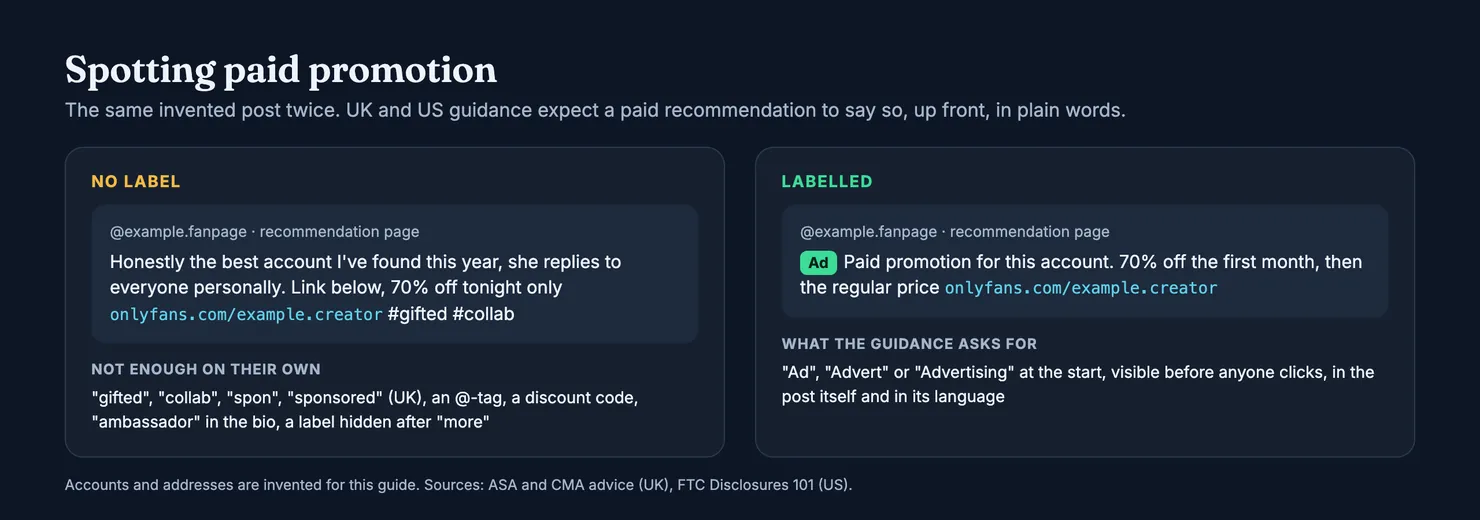
In the US, the Federal Trade Commission's guide Disclosures 101 for social media influencers says anyone endorsing something should disclose a financial, employment, personal or family relationship with the brand, and that free products count. The disclosure has to be hard to miss and sit with the post itself, not only on a profile page, behind a "more" link or buried in hashtags. Plain words such as "ad" or "sponsored" are what it asks for; "spon" or "collab" are not enough.
In the UK, the Advertising Standards Authority's advice on recognising ads on social media says content is an ad when a brand pays or gives any incentive, or when the poster is connected to the brand, and that brands and influencers are both responsible for making that obvious. It expects a clear "Ad" at the start and lists labels that do not count, "sponsored" and "gifted" among them. The page speaks directly to a brand or agency working with an influencer. The Competition and Markets Authority's guidance for content creators says the same from the consumer-law side: any incentive counts, including posts about your own business, and everyone involved in making the content shares the responsibility.
Is a recommendation page an ad?
If it is paid, or run by the people it promotes, then under this guidance it should say so. A page that recommends several creators in a row, each with a link and a discount code, and carries no label at all, is worth treating as advertising you have not been told about. That is a reflex rather than a verdict: the guidance is guidance, the regulators say so themselves, and none of it rules on any particular post.
What about fake reviews and testimonials?
The FTC has a separate rule on consumer reviews and testimonials. Its questions and answers say advertising agencies are not immune: they can be liable for writing or selling fake reviews or testimonials, or for paying for praise. A review that comes from an insider or an agent of the business needs a clear disclosure. So a "fan" praising an account in a thread, who in fact works for the people running it, is exactly the kind of testimonial the rule is about. You will rarely be able to prove that from outside. You can, however, weigh an unlabelled rave less than a plain report from someone with nothing to sell.
How to tell whether an agency runs the inbox
You usually cannot know for certain. Agencies are not listed anywhere public, the platforms do not show who logs in, and a creator can answer briskly, at odd hours, with a sales pitch, all by herself. What you can watch for is a cluster of signs, each weak on its own:
- No memory. She does not recall what you talked about last week, or asks the same questions again.
- Replies at every hour. Instant answers at three in the morning and at noon, every day, with no gaps.
- A voice that shifts. Spelling, emoji habits and tone change from one day to the next, as if different people were writing.
- The same opener for everyone. Other subscribers quote the exact welcome message you got.
- Attention that tracks spending. Warm and quick until you buy, then slow until the next offer.
Some creators say openly that a team helps with their messages, in the bio or the welcome note. That is the honest version, and it lets you decide what you are paying for. Absence of such a note proves nothing either way.
A related worry is whether the account is hers at all. An agency that runs an account is a different problem from an impersonator who copies a creator's photos, but the checks overlap. Our guide on how to spot a fake OnlyFans account covers near-identical handles and links that only go one way.
What you can check before paying
Start with what other subscribers saw. Search the account on Legit. Each profile carries two separate figures: an authenticity estimate built only from public facts about the account, and a chatter probability built from structured reports by people who subscribed. Where there is not enough evidence, we show no number at all rather than a guess.
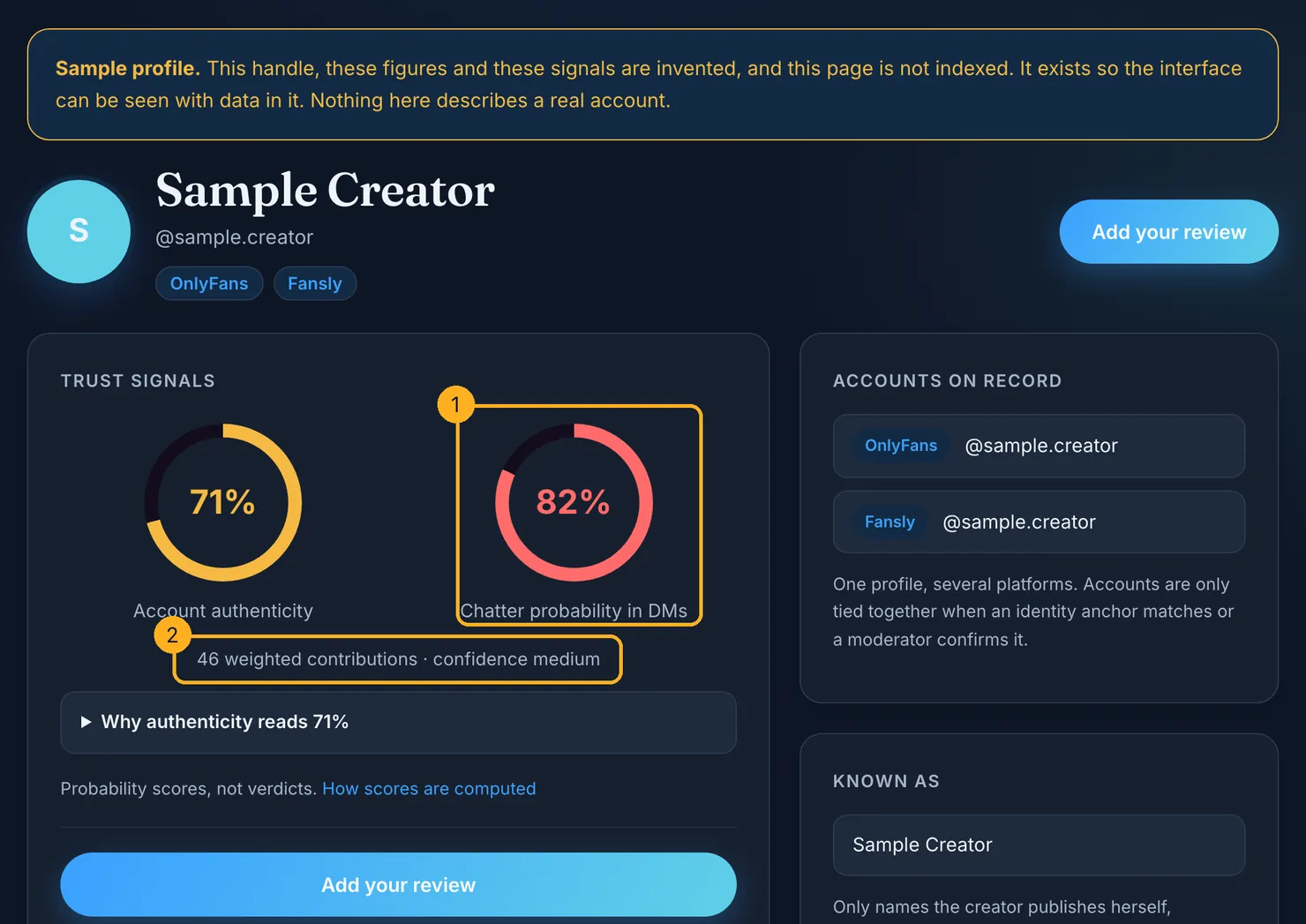
The chatter probability is the figure that speaks to agencies. It moves only when subscribers answer a short set of questions about the inbox, and each answer moves it by a fixed amount that we publish. The two that weigh most are whether replies remembered earlier conversations and whether the attention changed once you had paid, because those are the closest a subscriber can get to telling one person from a rota. Tone weighs less: plenty of people write briskly, and plenty of chatters are warm.
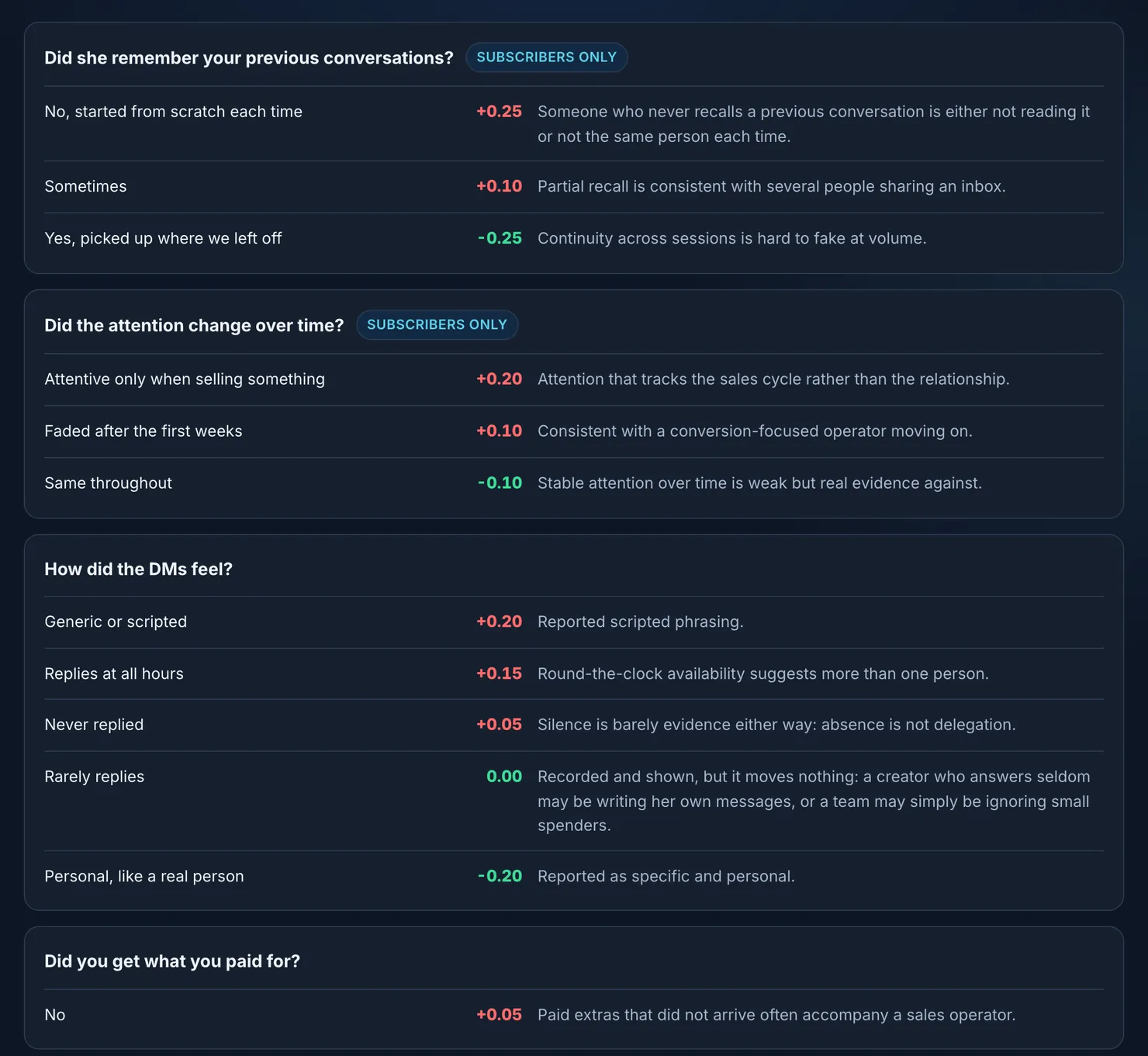
The full table, with every weight, is on our methodology page, loaded from the scorer itself. A report counts for more when it comes from a contributor with a track record, and more again when it comes with the platform's own e-mail receipt, which we verify by its cryptographic signature. Nothing anyone pays, creator or agency, moves either number.
A few more checks cost nothing:
- Read the bio. On Fansly a profile can be read before you pay, links in the bio included. Our Fansly vs OnlyFans guide explains what each platform shows from outside.
- Look at where you came from. If you found the account through an unlabelled recommendation, treat the praise as advertising.
- Start small. One month, auto-renew off, no bundles until you have seen how the inbox behaves.
If you already subscribe
Pay for messages only if you are comfortable with the chance that a team writes them. Keep every purchase and every agreement inside the platform: an arrangement made off-platform is the hardest to get back if something goes wrong, and our guide to OnlyFans refunds explains how narrow refunds are to begin with.
Then, once you have seen how the account behaves, add what you saw. It takes a swipe and a few short questions about the conversation, and it is what moves an account's chatter probability for the next person who wonders the same thing. You do not need to know whether an agency is involved. You only need to say what the messages were like.
Questions people ask
What is an OnlyFans agency?
It is a business that runs part of a creator's account in exchange for a share of her earnings. The creator still appears in the content. The agency may handle promotion on other social networks, the posting schedule, the prices of paid messages and bundles, and often the inbox, where a team of chatters answers subscribers in shifts.
Are OnlyFans agencies legit?
Using an agency is not banned by the OnlyFans terms we read, which say only that the creator stays legally responsible for everything done on her account. Whether a particular agency behaves honestly is another question. For a subscriber, what matters is whether the account says plainly who writes the messages and whether its promotion is labelled as advertising.
How can I tell if an agency is answering an OnlyFans account's messages?
Usually you cannot be sure. Watch for several signs together: no memory of earlier conversations, instant replies at every hour, a tone that shifts from day to day, the same opener other subscribers received, and attention that fades once you have paid. One sign means little. Reports from other subscribers on Legit show whether others noticed the same.
Do agencies have to say when they promote an account?
US and UK guidance says a paid or connected recommendation should be clearly labelled as an ad, in the post itself and up front. The FTC accepts plain words like 'ad' or 'sponsored'; the UK's ASA prefers 'Ad' at the start and does not accept 'sponsored' or 'gifted' alone. This is guidance from regulators, not a ruling on any particular post.
Can an agency use AI to chat with fans on Fansly?
Fansly's terms, quoted on its help page, do not allow AI systems to talk directly with users and produce personalised replies without human oversight, unless Fansly has given express written permission. AI material presented as an authentic human performance is not allowed either. The page does not explain how oversight is checked.
Does it matter to me if a creator uses an agency?
It matters most if you pay for messages. Content you buy is still hers, but a conversation you pay for may be written by a team. If that is fine with you, nothing changes. If it is not, check reports from other subscribers before you buy, start with a single month, and keep auto-renew off until you have seen how the inbox behaves.