Is an AI answering your OnlyFans messages?
It can happen, and from your side of the screen you can't prove it either way. What you can do is notice how the conversation behaves, know what the written rules say, and stop paying for attention that isn't there.
You cannot prove from one message that an AI wrote it. Software that drafts or sends chat replies exists and is sold to creators, and a reply it writes looks like any other message from her account. What you can do is watch the pattern over several days, know what each platform's rules allow, and stop paying for attention that does not hold up.
Can an AI really be answering your messages?
Yes. Tools that write chat replies for creators are on sale, and the press has reported on them openly. A VICE report described several kinds: some only suggest a reply that the creator then sends, others start conversations with subscribers who have gone quiet, and some run whole conversations based on earlier chats. Its conclusion was blunt: a paying subscriber has no reliable way of knowing which one they are talking to (VICE report on AI chat tools for creators).
That does not mean every account uses one. Nobody publishes a reliable count, and we won't guess. It means the question is fair to ask, especially if you are paying per message or tipping for a reply.
Why can't one message prove it?
Because the same inbox can be fed in at least six ways, and they all arrive as a message from her account.
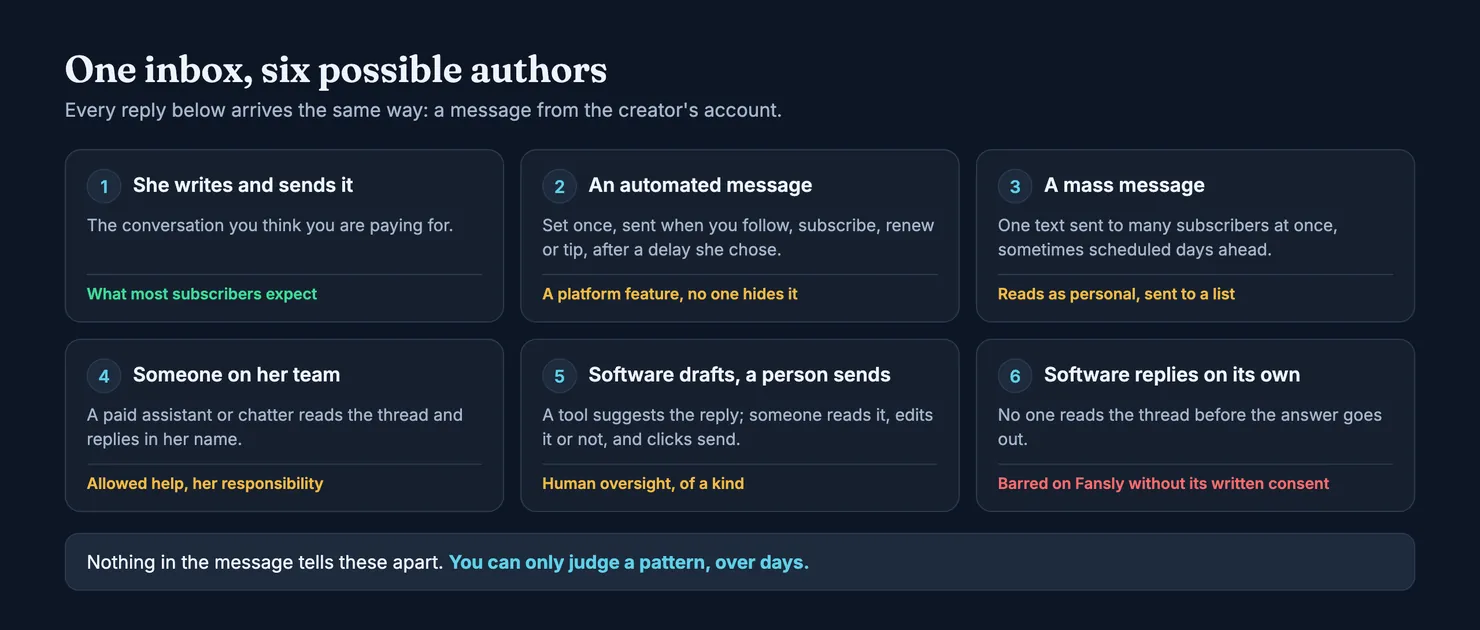
Some of these are ordinary platform features. Fansly, for example, lets a creator set a message that goes out by itself when you follow, subscribe, renew or tip, after a delay she chooses in seconds, with a cooldown so you don't get it twice (Fansly help: automated messages). A warm welcome a few seconds after you subscribe is very likely that. It tells you nothing about who writes the rest.
Mass messages are another. A creator can send one text to many subscribers at once and schedule it ahead. Fansly's own help page notes a detail worth knowing: when a mass message carries media, each person sees only their own like, so it always looks as if you were the first to react (Fansly help: mass messages). A message that feels written for you may have gone to a list.
Then come people: a creator who answers herself, or an assistant who replies in her name. Our guide to OnlyFans chatters explains how those teams work. Software sits at the end of that line, and it is often mixed in rather than alone: a tool drafts, a person skims and clicks send. A model's reply sent by a tired assistant reads much like a tired assistant's own reply.
Is an OnlyFans AI chatbot the same as a chatter?
Not quite, but from your side of the screen the difference is small. A chatter is a person paid to answer as the creator. An AI chatbot is software doing the same job, sometimes with a person checking it and sometimes without. In both cases the person you think you are talking to is not the one writing. What changes is how the conversation fails: a person forgets because they handle many threads; software forgets because it was not following the thread in the first place.
Signs worth noting in the replies
None of these proves anything on its own. They matter when several turn up in the same conversation, over days rather than minutes. Write down what you see, with dates, before you decide anything.
How do you tell if you're talking to an AI on OnlyFans?
- No memory. You mention something you said last week and get a warm reply that doesn't touch it. Or the same getting-to-know-you questions come back, as if this were your first chat.
- Answers that slide past specifics. Ask something concrete, like what she thought of a particular post, and you get praise for you instead of an answer about the post.
- Instant, polished replies at any hour. Long, well-formed messages arriving within seconds, at three in the morning and again at nine, in exactly the same tone.
- Every thread lands on a sale. Selling is normal on these platforms. Steering every subject, every time, towards a locked video or a price looks like a script, whether a person or a program runs it.
- Contradictions. She was at the beach yesterday and snowed in today. People lie too, but programs make this kind of slip without noticing, and without repairing it when you point it out.
- Odd phrasing. The same pet names and emoji pattern in every message, or replies that sound a little too much like a helpful customer service agent.
Short or slow replies are not a sign either way. A creator who writes her own messages may answer rarely and briefly. A team may ignore small spenders. Silence is not delegation.
What do OnlyFans AI responses tend to get wrong?
The weak points are the ones a model has trouble faking at volume: continuity and detail. It can keep a tone for a long time. It is much worse at remembering what you told it three days ago, at answering a precise question about something only the real person would know, and at staying consistent about her own day. That is why the most useful thing you can do is have a conversation that runs over several days and pay attention to whether it builds on itself.
Do trick questions work?
Sometimes, and not reliably. Asking someone to repeat a strange word or to prove they are human is a popular test in online threads about bots. It may catch a crude bot. A person following a script can fail it, a good tool can pass it, and a creator who is real may simply find it rude. Treat the result as one more sign, not a verdict.
Does OnlyFans allow AI? What the written rules say
Platform rules differ, and they change, so read each platform's own terms before relying on any of this. What follows is what we could read ourselves.
What is OnlyFans' AI generated content policy?
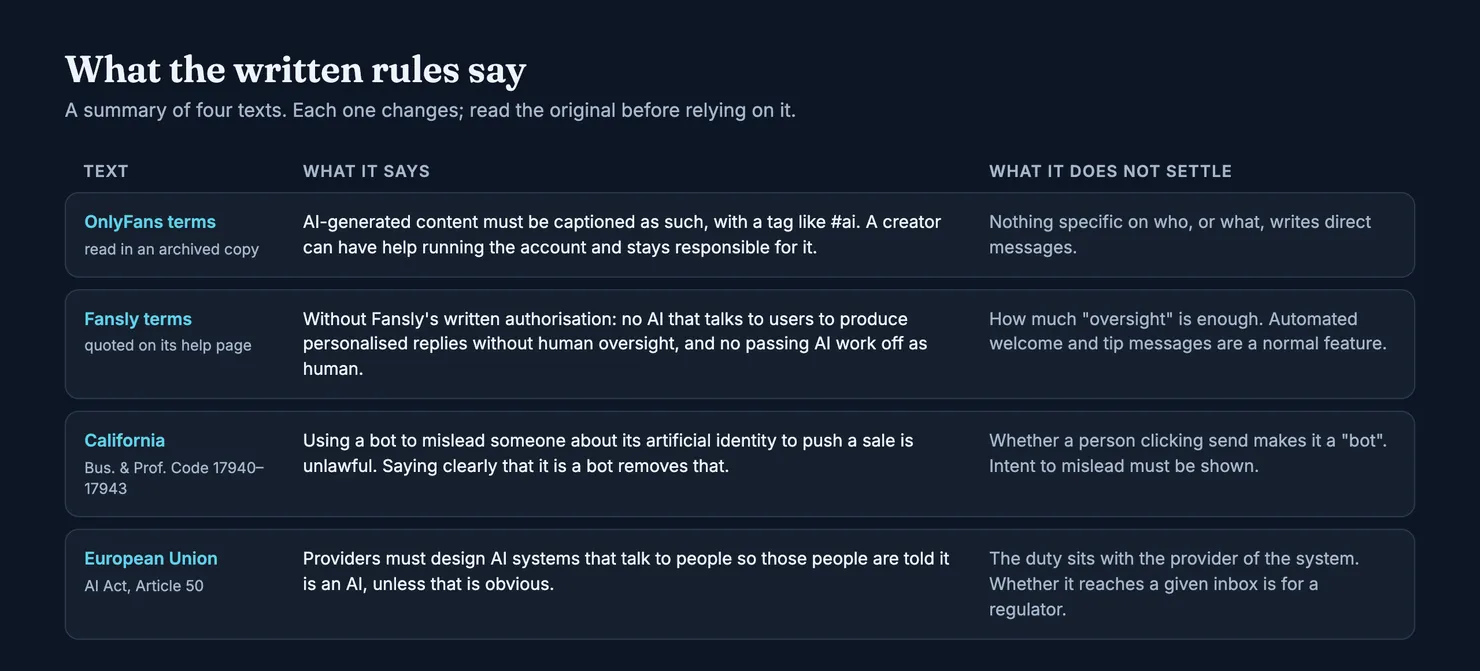
Our tools cannot open onlyfans.com directly, so we read its terms of service in an archived copy. Two clauses matter here. AI-generated content has to follow the terms like everything else and be clearly captioned as AI-generated, with a tag such as #ai or #AIGenerated. And when someone else helps a creator run her account, that does not change her legal responsibility: OnlyFans says its relationship is with her, not with whoever assists.
So help with an account is expected, and the creator answers for it. What we did not find in the text we could read is a clause specifically about who, or what, writes direct messages. The terms define direct messages as one of the paid interactions between a fan and a creator. Read the current version yourself before you rely on our summary: OnlyFans says it can change its terms at any time.
Does OnlyFans use AI itself?
That is a different question from whether creators do, and we have no OnlyFans page we can read that answers it for messages. The terms we read mention recommendation systems that can show creator accounts on the home page, and nothing about OnlyFans writing messages on a creator's behalf. If you see a reply that seems machine-written, the platform's terms point to the creator, not OnlyFans, as the one responsible for it.
What does Fansly say about AI replies?
Fansly's help page on AI content quotes its terms. Without Fansly's written authorisation, users may not post content where AI systems talk directly with users to produce personalised responses "without human oversight", nor anything that passes off AI-generated material as authentic human work (Fansly help: AI generated content; full text in the Fansly terms). The same page says content that breaks these rules can be reported with Fansly's reporting feature.
Note the phrase "without human oversight". A tool that drafts and a person who approves sits in a grey zone the page does not define. A bot that answers on its own, with no one reading, is plainly what the rule describes.
And the law?
In California, the bot disclosure law makes it unlawful to use a bot to talk to someone online with the intent to mislead them about its artificial identity in order to push a sale. It defines a bot as an automated account where all or nearly all of the activity is not the result of a person, and saying clearly that it is a bot removes the liability (California Business and Professions Code, sections 17940 to 17943).
In the EU, Article 50 of the AI Act requires providers of AI systems that interact directly with people to design them so those people are told they are dealing with an AI, unless it is obvious (EU AI Act on EUR-Lex; Article 113 sets when each part applies).
Both texts come with conditions: intent to mislead in California, a duty on the provider of the system in the EU, and a definition of "bot" that a human pressing send may fall outside. Whether either applies to a given inbox is a question for a regulator or a court, not for us. What they show is that telling people they are talking to software is the expected norm, not a favour.
Why AI chatbots for OnlyFans change what you are paying for
On these platforms you pay for two different things: content you can see, and attention. Content is what it is; you can judge a photo or a video before or after you buy it, and our guide to OnlyFans refunds covers what happens when it does not arrive. Attention is harder. A paid message, a tip for a reply, a custom request negotiated in chat: all of these assume someone is reading.
When software writes the replies, the attention part of the price is worth less, and the sales pressure can be greater, because a program does not get tired of nudging you towards the next purchase. For most subscribers that matters more than any rule.
What you can do
- Stop paying for the conversation itself. If what you are buying is attention, and the attention looks automated, the cheapest test is to stop tipping for replies and see what changes. Pay for content you can see, at a price you would accept from a stranger.
- Ask directly. "Is this you, a team, or a tool?" You may not get a straight answer. A dodge is information too.
- Keep your money on the platform. A request to pay by gift card or crypto, or to move to another app, is a bigger problem than who writes the messages. The US Federal Trade Commission warns that people who push to move a conversation off the platform and then ask for money are a classic warning sign, and that money sent by gift card, wire or crypto is hard to get back (FTC consumer advice). Our guide on whether OnlyFans is safe covers payments in more detail.
- Check the account, not only the messages. An account that impersonates a creator may use automated replies to keep you paying. Our guide to spotting a fake account explains the checks, and our guide to OnlyFans agencies covers who else may be behind a profile.
- Report it. Use the platform's report button on the profile or the message, and say what you saw. On Fansly, AI replies without human oversight are a listed breach of the terms.
- Tell other subscribers. Rate the account on Legit and describe how the DMs behaved, in your own words.
What Legit can and can't tell you
Each profile on Legit carries a chatter estimate: how likely it is that someone other than the creator answers the messages.
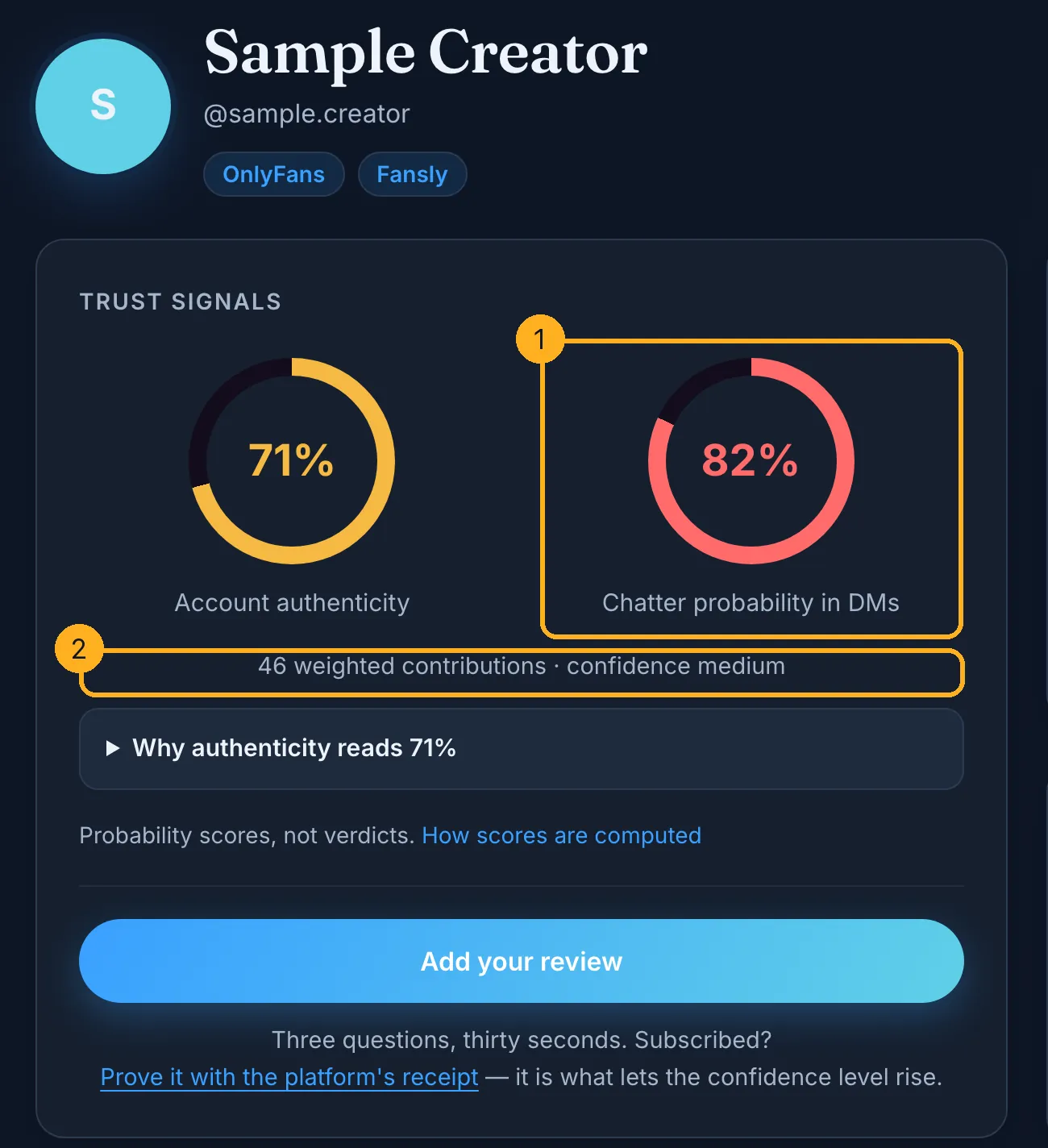
It comes from what subscribers report: whether she remembered earlier conversations, whether the attention changed over time, and how the messages felt (scripted, replies at all hours, personal). The two questions about memory and attention carry the most weight, and only people who say they subscribed can answer them. A contribution counts double when the contributor proved the subscription with the platform's own receipt, which we check by its signature. Every rule and its weight is on our methodology page.
That estimate does not separate a person on a team from a program. Both count as "not her", and we have no tool that detects AI in messages, so we don't claim one. If too few people have reported, there is no figure at all, and the page shows a dash rather than a guess.
Before you start paying for messages, look the account up on Legit and read what others noticed. If you have been through a conversation that felt automated, adding what you saw is the most useful thing you can do for the next person.
Questions people ask
How can you tell if you're talking to an AI on OnlyFans?
You cannot prove it from one message. Look at the conversation over several days: replies that forget what you said before, answers that avoid concrete questions, long polished messages at any hour, and every topic steered towards a sale. Several of these together are worth noting. None of them alone is proof, because a person on a team can behave the same way.
Does OnlyFans allow AI?
OnlyFans' terms, read in an archived copy, say AI-generated content must follow the terms and be clearly captioned as AI-generated, with a tag such as #ai or #AIGenerated. They also say a creator who gets help running her account stays legally responsible for it. Terms change, so read the current version on OnlyFans before relying on this summary.
Does OnlyFans use AI to answer messages for creators?
Nothing we could read on OnlyFans' own pages says the platform writes messages on a creator's behalf. Tools that do this are sold to creators by other companies, according to press reports. Under OnlyFans' terms, the creator remains responsible for what is sent from her account, whoever or whatever writes it.
Is an OnlyFans AI chat bot allowed on Fansly?
Fansly's terms, quoted on its help page, bar content where AI systems talk directly with users to produce personalised responses without human oversight, unless Fansly has given written authorisation. They also bar passing off AI-generated material as authentic human work. Automated welcome and tip messages that a creator sets up herself are a normal Fansly feature.
Are AI chatbots for OnlyFans legal?
It depends on where you are and how the tool is used. California makes it unlawful to use a bot to mislead someone about its artificial identity in order to push a sale, unless it is clearly disclosed. The EU AI Act requires providers of conversational AI to tell people they are talking to an AI. Whether either applies to a given inbox is for a regulator or a court.
Can Legit tell whether a creator's replies come from an AI?
No. Legit's chatter estimate shows how likely it is that someone other than the creator answers the messages, based on what subscribers report. It cannot separate a person on a team from a program, and Legit has no tool that detects AI in messages. When too few people have reported, the profile shows a dash instead of a figure.